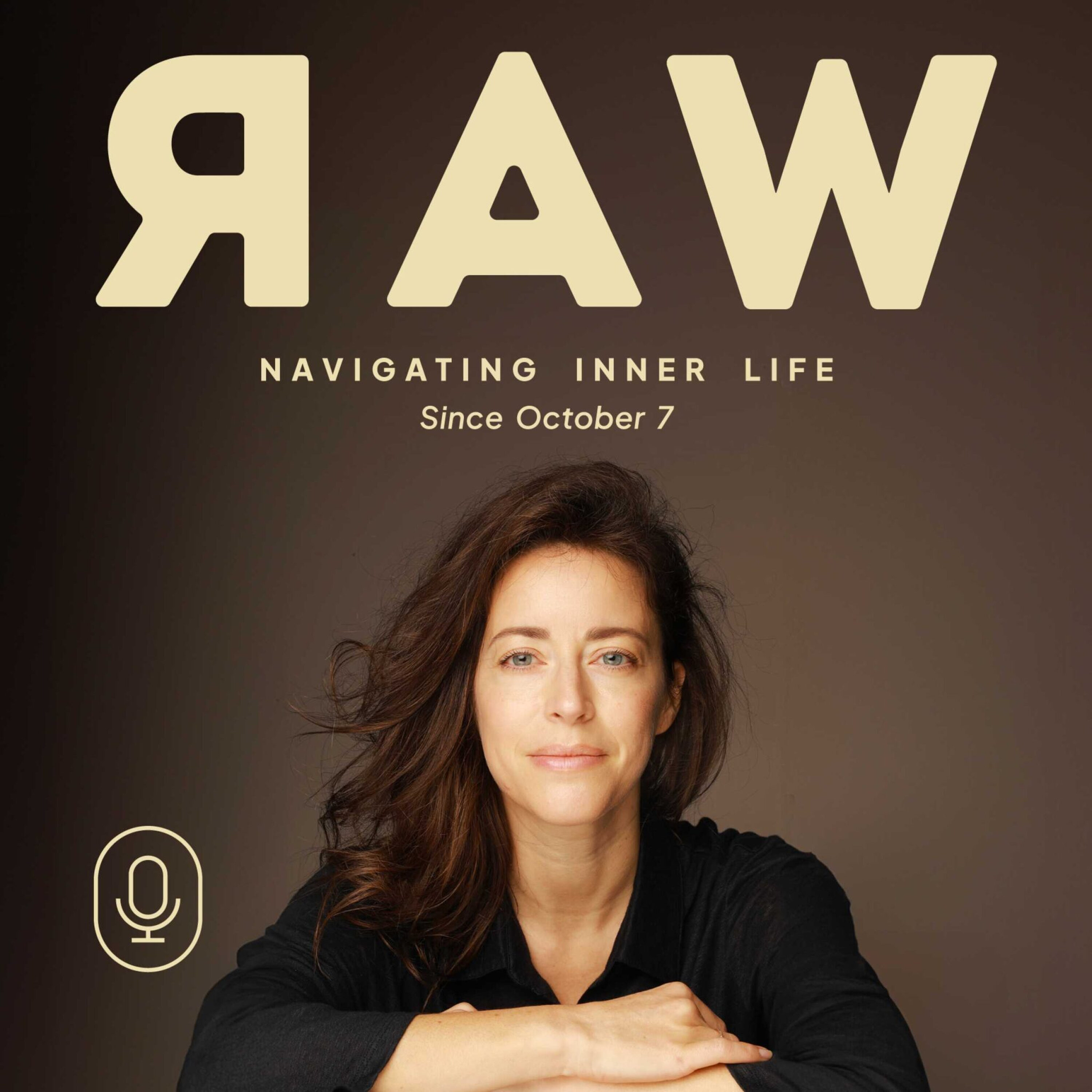
'Raw' is a podcast that confronts the complexities of war from the inside out. Hosted by Anouk Lorie—journalist, author, and yoga and meditation teacher—'Raw' embodies the collective sense of exposure and vulnerability many of us feel in the wake of Israel's conflicts. This show goes beyond discussing external events, diving deep into our inner battles and how these moments of violence shake our very core.
Join Anouk in intimate conversations with leading philosophers, psychologists, spiritual leaders, and trauma experts. Together, they explore how we can navigate these painful times with wisdom and resilience, offering guidance for our paths in an unfiltered, raw world. Whether you seek deeper understanding, tools for emotional resilience, or are seeking comfort and solidarity, 'Raw' invites you to listen, learn, and heal.
Follow and subscribe on your preferred podcasting platform:
• Spotify
• Apple Podcasts
• YouTube
Don't miss an episode—tune in and be part of the conversation that matters.
For more updates on episodes, tools for resilience and wellbeing, and inspiration, subscribe to our newsletter at withanouk.com.
In the aftermath of October 7, when so much was shattered, Dr. Lia Naor helped build something extraordinary. Within days, she and a small group of colleagues created what became known as the Healing Space in Rishpon, a volunteer-run trauma center that has since cared for more than 20,000 people, offering over 60,000 hours of therapy in dozens of healing modalities. It became a living sanctuary for survivors, evacuees, and therapists — a place where people could gather, breathe, and slowly return to themselves. Lia Naor is a clinical psychologist, researcher, and national representative of the International Ecopsychology Society. Her work stands at the intersection of psychology, nature, ritual, and community, exploring how the land itself can become a partner in recovery and how belonging and connection to place can help restore what trauma has torn apart. This conversation is about the deep ecology of healing: how we root ourselves again in life after devastation, how beauty and grief can coexist, and how acts of care, both human and ecological, become quiet forms of resistance. ✨ Subscribe to RAW wherever you listen to podcasts, and join the mailing list at WithAnouk.com for new episodes, reflections, and meditations.
When the hostages came home, Israel exhaled - but only for a moment. Because what comes after survival is its own kind of reckoning. In this conversation, clinical psychologist and psychoanalyst Iris Gavrieli Rahabi reflects on the unseen work of healing after collective trauma. A member of the Israel Psychoanalytic Society and longtime teacher in Human Spirit — a psychoanalytic–Buddhist training program that bridges Western depth psychology and Eastern contemplative practice — Iris has dedicated her career to understanding the meeting point between psyche, suffering, and compassion. She is also the co-founder of First Line Med, a volunteer network that has provided long-term, free therapy to survivors of the October 7 attacks, to bereaved families, and to those who returned from captivity. We talk about what it means to accompany others through devastation - when the cameras are gone and the quiet grief begins. How psychoanalysis and Buddhism meet in tenderness and truth-telling. And how healing, both individual and collective, asks us to stay present to the unbearable - without turning away. ✨ Subscribe to RAW wherever you listen to podcasts — and join the mailing list at WithAnouk.com for new episodes, reflections, and meditations.
Nearly two years since October 7, 2023, we are still learning to live with uncertainty — the shock, fear, and endurance that have shaped these years. In this gentle, grounding meditation, Anouk invites you to pause: to breathe with what is unresolved, to soften around what hurts, and to open — carefully — to the quiet possibility of hope. This isn’t about forced optimism, but about resting in truth and finding steadiness within it. If this practice resonates, subscribe to RAW with Anouk on Spotify, Apple Podcasts, or YouTube — and share it with someone who might need a moment of calm today.🕊️
Gina Ross is a psychotherapist and founder of the International Trauma-Healing Institute. In this episode, she shares simple, practical tools anyone can use to calm the nervous system and release trauma energy in daily life — alongside insights from her decades of work in conflict zones and communities worldwide. Gina has trained thousands of professionals and community leaders in trauma-healing methods that bridge psychotherapy, neuroscience, and cross-cultural awareness. Her mission: to stop cycles of trauma before they spiral into cycles of violence. In this episode we explore: Simple, on-the-go tools to regulate the nervous system How trauma energy gets stuck in the body — and how to safely release it Ways to use these techniques in moments of overwhelm, reactivity, or stress The wider picture of collective trauma in Israel, Palestine, and beyond How trauma is transmitted across generations — and how healing can interrupt that cycle This conversation is both practical and profound: a chance to learn tools you can use right now, and an invitation to see trauma not only as a wound, but as a pathway toward resilience and repair. Subscribe to RAW on any podcast app.
In this special 10-minute guided meditation from Raw, we pause amid war, heat, and division to honor both the call to act and the need to rest. Through the rhythm of breath, we explore resilience—the balance between rising with strength and softening into renewal. The meditation closes with a Hebrew blessing, offered as both prayer and poetry, for strength and peace.
Raw is a podcast of unguarded conversations and practices about resilience, morality, and healing in the shadow of war. Subscribe on all podcast apps or join the newsletter at WithAnouk.com
What does it mean to meet conflict—not with reactivity or avoidance—but with presence, clarity, and a willingness to go deeper? In this episode of RAW, Anouk sits down with therapist and conflict facilitator Gary Reiss and Aikido teacher and meditation guide Miles Kessler—two longtime friends who bring decades of experience in trauma healing, martial arts, and group facilitation. Gary shares insights from his work in Israel and the Palestinian territories, including collaborations with trauma experts on both sides. Drawing from Process-Oriented Psychology, he explores how we can access the wisdom hidden within personal and collective tension—even, and especially, in heartbreaking times. Miles brings the perspective of Aikido, a martial art rooted in harmony and non-resistance, and how its philosophy can help us engage conflict with grounded strength rather than force. Recorded during Gary’s recent visit to Tel Aviv, where the two were leading joint events, this conversation invites us to reflect on what it means to respond—not react—in the midst of profound uncertainty.
For more episodes, reflections, and guided meditations, subscribe to RAW on your favorite podcast platform.
Sign up for Anouk’s newsletter at withanouk.com to receive updates, transcripts, and new conversations exploring resilience, morality, and healing in times of war.
About the Guests:
Gary Reiss is a therapist, author, and international trainer in Process-Oriented Psychology, also known as Process Work—a therapeutic approach for navigating personal, relational, and societal conflict. He has worked extensively in Israel and the Palestinian territories, collaborating with trauma experts on both sides. Gary integrates psychology with Taoism, shamanism, and Jewish mysticism in his work.
Miles Kessler is a 6th Dan Aikido teacher, meditation guide, and founder of the Integral Dojo in Tel Aviv. With dual lineage in the Iwama Aikido tradition and the Burmese Mahasi meditation tradition, Miles brings embodied wisdom to his teaching and facilitation. He also leads Aikido Without Borders, a non-profit dedicated to peacebuilding through practice.
In the aftermath of the Israel–Iran escalation — amid an ongoing war, summer fatigue, and collective grief — this short guided meditation offers a place to pause, ground, and soften.
Led by Anouk, this 10-minute practice invites you to rest into your body, name what’s present, and gently cool the nervous system. Whether you're feeling tired, tense, or overwhelmed by the heat within and around you, this meditation offers a quiet refuge to return to what’s steady and alive.
Breathe. Soften. And remember: you are not alone.
For more meditations and conversations on resilience, war, and the human spirit, follow RAW with Anouk.
Dr. Rick Hanson is one of the most respected voices in psychology—a New York Times bestselling author, Senior Fellow at UC Berkeley’s Greater Good Science Center, and a world-renowned teacher of emotional healing and resilience. His groundbreaking work blends neuroscience, mindfulness, and practical tools for inner transformation.
In this urgent and intimate conversation, recorded as Iranian missile barrages rained over Israel, Dr. Hanson speaks about what happens to the brain and body under constant threat—and how we can stay steady, compassionate, and connected when everything around us feels unsafe. We talk about intergenerational trauma, the science of epigenetics, and how moments of connection—even in war—can begin to rewire the nervous system toward healing.
He also shares simple, research-backed practices for calming the body, supporting children while feeling afraid ourselves, and staying open-hearted in a time of sirens, shelters, and sorrow.
This episode was recorded at home, without studio equipment, during a period of lockdown. My voice is hoarse, my kids were nearby, and the audio is imperfect—but the conversation is deeply human, generous, and needed.
If you’ve been feeling frayed, frightened, or overwhelmed—this conversation is for you.
🎧 Listen & Subscribe: 📌 Apple Podcasts 📌 Spotify 📌 YouTube 📩 Subscribe to my newsletter: www.WithAnouk.com 📸 Follow on Instagram
This guided meditation is an invitation to pause and reconnect with a deeper sense of wholeness, even in the midst of pain or uncertainty. You’ll be gently guided to relax, tune into your breath and body, and soften around the places that feel fractured—without needing to fix or change anything.
Whether this is your first time meditating or a familiar practice, you’re welcome just as you are. If your mind drifts, that’s completely normal—simply notice and come back to your breath or the sound of the words. That gentle return is the practice.
Inspired by Leonard Cohen’s line, “There is a crack in everything—that’s how the light gets in,” this meditation offers space to rest, feel, and remember your quiet strength beneath it all.
You can subscribe to RAW podcast meditations and conversations wherever you get your podcast.
If the podcast resonates, please share it with someone else who might enjoy it.
🎧 Listen & Subscribe: 📌 Apple Podcasts 📌 Spotify 📌 YouTube 📩 Subscribe to my newsletter: www.WithAnouk.com 📸 Follow on Instagram
What if mindfulness wasn’t just a wellness tool, but a moral imperative—especially for those in power?
In this episode, neuroscientist and mindfulness teacher Dr. Nava Levit-Binnun joins Raw to explore how contemplative practice can deepen our resilience, expand our capacity to hold complexity, and transform the way we meet this moment of crisis. Drawing from her background as the director of the Sagol Center for Brain and Mind at Reichman University, Nava shares how mindfulness has helped her navigate war, trauma, and uncertainty—not as an escape, but as a way to stay grounded in clarity and compassion.
We explore: Why mindfulness should be a prerequisite for leadership How the practice expands our window of tolerance Where to begin—especially in times of personal and collective upheaval How mindfulness reshapes the way we experience and respond to reality
This episode is part of a new rhythm: Raw will now alternate weekly between interviews and guided meditations. You can find the latest meditations—especially created for this time of great difficulty—on the podcast page.
If this conversation resonates, please rate, review, or share with someone who may need it.
🎧 Listen & Subscribe: 📌 Apple Podcasts 📌 Spotify 📌 YouTube 📩 Subscribe to my newsletter: www.WithAnouk.com 📸 Follow on Instagram
This short guided meditation is an invitation to return to your breath in the midst of uncertainty, conflict, and emotional overload. Whether you're walking, driving, or sitting, you don't need to close your eyes or be a seasoned meditator. All that’s asked is your presence. Inspired by a poem from Yehuda Amichai, this practice offers a soft landing for your nervous system. It’s not about escape. It’s about remembering your humanity—one breath, one heartbeat at a time. This is for anyone feeling unsettled, skeptical, or simply in need of a moment of stillness. Subscribe to RAW wherever you get your podcasts, or visit www.WithAnouk.com for more.
On this episode of RAW, I speak with Yossi Klein Halevi—author, historian, and public intellectual whose voice is vital in conversations about Israel, Jewish identity, and moral complexity in times of crisis. Yossi was born in Brooklyn to a family of Holocaust survivors. His father, a Hungarian Jew, survived the war as a teenager by hiding for months in a frozen ditch in the forests of Transylvania—a story that shaped Yossi’s worldview and sense of Jewish responsibility. He moved to Israel in 1982 and is now a senior fellow at the Shalom Hartman Institute in Jerusalem. His acclaimed books include Like Dreamers, about the paratroopers who reunited Jerusalem in 1967, and Letters to My Palestinian Neighbor, a courageous effort to bridge one of today’s most painful divides. We talk about the current war and what it reveals—about Israeli society, leadership, and the nation’s soul. We explore how the shadow of the Holocaust continues to shape Yossi’s view of the Jewish state, and the impossible tensions between survival and conscience. We also touch on Yossi’s long-standing meditation practice, and how it helps him stay spiritually elevated and emotionally grounded through heartbreak and chaos. This is a conversation about moral clarity and humility. About fear, grief, memory—and the quiet practices that help us stay human. 🎧 Listen & Subscribe: 📌 Apple Podcasts 📌 Spotify 📌 YouTube 📩 Subscribe to my newsletter: www.WithAnouk.com 📸 Follow on Instagram Don't miss an episode—tune in and be part of the conversation that matters. For more updates on episodes, tools for resilience and wellbeing, and inspiration, subscribe to our newsletter at WithAnouk.com.
Today on RAW, I speak with Ruti Dariel—mother of three, psychotherapist, expressive arts therapist, and certified parenting coach with over 20 years of clinical experience. Ruti’s journey is deeply personal and profoundly relevant to this moment. A few years ago, despite her professional expertise, she found herself facing questions many parents know intimately: How do I truly connect with my child when things get hard? How do I set boundaries without losing myself? How do I respond to frustration and aggression in a way that actually helps? Especially as a mother of highly sensitive children, Ruti realized that many conventional parenting tools simply didn’t reach far enough. Her search for deeper understanding led her to the attachment-based developmental approach, through years of study at the Neufeld Institute and beyond. In this conversation, we explore the emotional toll of living—and parenting—through war in Israel. I asked Ruti: How does ongoing conflict affect our children, especially the more sensitive ones? How can we stay emotionally present when we’re anxious and afraid ourselves? What can we do when our kids act out or shut down—and how do we help them find resilience and hope? And how do we talk to children about things like fear, bereavement, and the future in ways that are age-appropriate and honest? Ruti offers not just wisdom, but warmth—a sense that we’re not alone in our struggle to show up for our children in such uncertain times. This episode is for any parent asking: How do I hold my child’s heart, even when mine feels heavy? 🎧 Listen & Subscribe: 📌 Apple Podcasts 📌 Spotify 📌 YouTube 📩 Subscribe to my newsletter: www.WithAnouk.com 📸 Follow on Instagram
Dr. Dalia Marx—one of the most respected voices in contemporary Jewish thought and liturgy. We talk about how October 7 and the war since have brought profound and rapid changes to the world of Jewish prayer: the language, the focus, even the urgency. Rabbi Marx also shares her reflections on the Jewish responsibility to bring our hostages home, and the prayers—old and new—that have sustained her through these past eighteen months. It’s a moving, grounded, and deeply thoughtful conversation with someone who has dedicated her life to holding the sacred and the human, side by side. 🎧 Listen & Subscribe: 📌 Apple Podcasts 📌 Spotify 📌 YouTube 📩 Subscribe to my newsletter: www.WithAnouk.com 📸 Follow on Instagram About Rabbi Dr. Dalia Marx Rabbi Marx is the Rabbi Aaron D. Panken Professor of Liturgy and Midrash at the Hebrew Union College–Jewish Institute of Religion in Jerusalem. She is the first woman in Israel to hold a professorship in liturgy and is a trailblazer in both academic and spiritual circles. Her work bridges scholarship and lived practice, and she is the author of several books, including When I Sleep and When I Wake: On Prayers Between Dusk and Dawn. She’s also a contributor to the new Israeli Reform prayerbook, and a leading voice in shaping how prayer responds to collective trauma, grief, and hope.
In this episode of Raw, I speak with Professor Eran Halperin, a leading expert on conflict resolution, political psychology, and the emotional dynamics that shape intergroup relations. As Israel grapples with the aftermath of October 7 and the ongoing war, Professor Halperin brings his deep expertise to unpack the psychological forces at play—how fear, anger, and trauma shape public opinion, decision-making, and the possibility (or impossibility) of reconciliation. We discuss the cognitive and emotional barriers to peace, what history teaches us about societies in prolonged conflict, and whether there is a path forward in times of such deep division. This is a conversation that cuts through the noise, offering a nuanced, research-based perspective on one of the most complex and painful moments in modern history. 🎧 Listen & Subscribe: 📌 Apple Podcasts 📌 Spotify 📌 YouTube 📩 Subscribe to my newsletter: www.WithAnouk.com 📸 Follow on Instagram About Professor Eran Halperin Eran Halperin is a professor of psychology at the Hebrew University of Jerusalem and a world-renowned expert on political psychology, conflict resolution, and the role of emotions in shaping intergroup dynamics. His research focuses on the cognitive and emotional mechanisms that sustain conflicts, as well as interventions that can promote change. He has advised policymakers and peace-building initiatives worldwide and has published extensively in leading academic journals.
In today's conversation, therapist Danny Cohen takes us into the heart of some of our most difficult emotions: grief, rage, and loss, especially in the wake of October 7th. How do we meet these emotions without shutting down? How do we allow them to transform us rather than consume us?
Danny Cohen is a profoundly thoughtful soul whose work integrates Jewish wisdom, contemplative practice, and trauma-informed therapy. Danny has spent years guiding individuals and communities through the deepest terrains of healing. He leads retreats—among others, for caregivers and therapists of trauma survivors—helping those who hold space for others find their own inner refuge.
Danny's approach is informed by his studies in mindfulness, somatic psychotherapy, and communication-based healing modalities. He has trained in nonviolent communication, Hakomi mindfulness-based somatic therapy, organic intelligence, and transformative change work.
In this conversation, we speak about tribalism, and the role of spiritual practice in holding pain without being overwhelmed by it. He also shares a remarkable experience with a German man who carried deep anti-Semitism—an encounter that shifted in an unexpected and powerful way. Additionally, he takes me through some therapeutic exercises, offering a glimpse into his deeply restorative approach. Throughout, he weaves beautiful teachings from Jewish spiritual texts into our exploration of resilience and healing.
💡 If this conversation resonates with you, remember to: ✅ Subscribe to Raw on your favorite podcast platform. ✅ Rate & review the show—it helps others find these important discussions! ✅ Sign up for my newsletter at withanouk.com for more reflections, insights, and behind-the-scenes content. ✅ Share this episode with anyone who might find it valuable.
Psychedelics have long been intertwined with human consciousness, healing, and transformation—but what happens when they intersect with trauma, crisis, and cultural shifts? In this episode of Raw, I sit down with Nir Tadmor, a transpersonal psychotherapist, psychedelic integration specialist, and leading voice in harm reduction. As the Educational Director at Impulse, co-founder of Safe Shore, and a research associate at Haifa University's Neurophenomenology Lab, Nir has spent years working with individuals navigating non-ordinary states of consciousness and mental health crises. We dive into the complex relationship between psychedelics, the Israeli trans music community, and trauma, exploring how these substances have shaped culture and what they meant for Nova Festival survivors who were under the influence during the October 7 attack. We also discuss the evolving field of psychedelic-assisted therapy, where it's headed, and how to engage with it safely and meaningfully. Finally, we explore new research on altered states, what we can learn from survivors, and the future of mental health and therapy. This is a raw, thought-provoking conversation about the transformative potential—and very real risks—of psychedelics, and how we can create safer, more intentional spaces for healing. 💡 If this conversation resonates with you, don't forget to: ✅ Subscribe to Raw on your favorite podcast platform. ✅ Rate & review the show—it helps others find these important discussions. ✅ Sign up for my newsletter at withanouk.com for more reflections, insights, and behind-the-scenes content. ✅ Share this episode with anyone who might find it valuable.
In this short episode, I share the story behind RAW—why I created this space for wisdom, resilience, and compassion in the wake of October 7. Amid fear, grief, and division, I wanted to bring together voices that help us meet this moment with depth and humanity. I also have a request: What has helped you stay grounded? Who would you like to hear on the show? I’d love to hear from you. Reach me at anouk@withanouk.com and find more at www.WithAnouk.com. If RAW resonates, please share—it makes all the difference. Thank you for being on this journey with me.
Today on the show, we welcome Dr. Noam Weissman, Executive Vice President of OpenDor Media, where he leads a team of producers and educators to reach millions of young Jews yearly through articles, videos, and social media about Israel and the Jewish people. As the host of Unpacking Israeli History, the #1 Jewish podcast, he’s known for breaking down complex historical narratives with honesty, nuance, and a touch of humor.
In today’s conversation, he brings that same clarity and candor to a more personal level. We talk about how he actively works to confront his own biases and tribal instincts, the challenges of teaching history in an increasingly polarized world, and why he believes that intellectual honesty is the key to meaningful discourse. He also reflects on the past year—both professionally and personally—with his signature mix of humor, and thoughtfulness."*
With a doctorate in Educational Psychology from USC and years of experience as an educator and school principal, Noam is deeply committed to helping students—and all of us—navigate history without falling into ideological traps.
Follow and subscribe on your preferred podcasting platform:
• Spotify • Apple Podcasts • Youtube
For more updates on episodes, tools for resilience, and inspiration, subscribe to our newsletter at WithAnouk.com
Today on the show, we speak with Galit Levin, founder of the Kaden Association and Kaden College. Galit is a yoga teacher, yoga therapy expert, and teacher of meditation and the philosophy of yoga. She leads workshops and retreats both in Israel and around the world. In our conversation, we explore her belief that labeling difficult emotions like anxiety or trauma as “bad” does a disservice to the deep and natural wisdom they hold. Galit shares her perspective on how to view these emotions in a different light and how that shift can impact our lives for the better. She also reflects on the year since October 7 and why it awakened a profound connection to Judaism. Listen now and subscribe on Apple Podcasts, Spotify, and YouTube.
This guided visualization from the Raw podcast invites you to step into 2025 with intention. In the midst of war, uncertainty, and collective grief, this practice creates space to reflect on where we’ve been, honor our resilience, and imagine what healing could look like for ourselves and our communities. 🌿 What you'll experience: • Grounding in the present moment. • A visualization of healing for yourself and the world. • Setting an intention or word to guide your year ahead. This is not about erasing the challenges we face but about holding them alongside the hope for renewal. 🎧 Find more episodes exploring resilience, healing, and humanity on Spotify, Apple Podcasts, and YouTube, or visit WithAnouk.com to sign up to the newsletter.
On October 8th, Ohad Ufaz, an award-winning filmmaker and documentarian, was part of a leading team of 400 filmmakers and mental health professionals undertaking an extraordinary mission: recording video testimonies from survivors of the October 7th massacre.
With years of experience in storytelling and a deep commitment to social impact, Ohad has dedicated his career to amplifying voices that might otherwise go unheard.
In this episode of *Raw*, Ohad shares his personal journey, the challenges and responsibilities of documenting deeply personal and traumatic stories, and the delicate balance between preserving history and supporting survivors.
We explore how this critical work not only safeguards truth but also serves as a powerful tool for healing and resilience, offering hope in the face of unimaginable loss.
In this deeply moving episode of Raw, we speak with Maoz Inon, an Israeli entrepreneur and peace activist whose life took a profound turn following the tragic loss of his parents in the Hamas attack on Israel on October 7, 2023. Despite the immense personal pain, Maoz has become a powerful voice for forgiveness, understanding, and peace in one of the most conflicted regions of the world. Maoz shares his journey of resilience and activism, from his impactful work in responsible tourism—building initiatives like the Jesus Trail and Abraham Hostels that promote cultural connection—to his recent, heartfelt calls for an end to violence between Israelis and Palestinians. Together, we explore the complexities of grief, the courage to choose peace over vengeance, and the profound hope for a better future. This episode is a testament to the strength of the human spirit and a call to action for empathy and dialogue in times of division. Join us for an unforgettable conversation that will inspire reflection and hope. Follow and subscribe on your preferred podcasting platform. • Spotify • Apple Podcasts • Youtube For more updates on episodes, tools for resilience, and inspiration, subscribe to our newsletter at withanouk.com..
In this deeply insightful episode of Raw, I sit down with Smadar Miller—an educator, writer, and founder of transformative programs like “Krovim” for relationships and sexuality, and “Miller College” for women’s financial empowerment. With a unique blend of expertise in relationships, sexuality, and self-fulfillment, Smadar shares her profound perspective on how collective trauma, like the ongoing war, impacts intimacy, desire, and our connection to ourselves and others. We delve into: • The events of October 7 as a “symbolic assault” on Israeli society and their ripple effects on personal and collective sexuality. • The challenges couples face during prolonged conflict—disrupted routines, long separations, and the impact on intimacy. • How sexuality can serve as a healing force, reconnecting us to our bodies, our partners, and the present moment. • Tools and practices for rebuilding intimacy and rediscovering pleasure during times of immense stress. • Insights into parenting and how to talk to children about sexuality in ways that foster security and resilience. Smadar’s thoughtful approach integrates culture, body awareness, and emotional independence, offering a roadmap for navigating relationships and intimacy even in the most challenging times. Whether you’re seeking solace, understanding, or tools for growth, this episode will inspire and empower you. Tune in for a conversation that bridges the personal and the universal, reminding us of the healing power of connection. Follow and subscribe on your preferred podcasting platform: • Spotify • Apple Podcasts • Youtube For more updates on episodes, tools for resilience, and inspiration, subscribe to our newsletter at withanouk.com.
In the year since October 7th, an unprecedented wave of trauma has deeply affected the Israeli psyche. One year later, I am honored to welcome an extraordinary guest, Oded Arbel—a leading psychiatrist who has intensified his efforts to help soldiers and citizens heal from trauma since that fateful day. Oded manages the 'Gevim' day care unit at the Be'er Sheva Mental Health Center, where he treats complex cases of trauma, including sexual trauma. He is also the head psychiatrist for the Israeli army and for soldiers returning from Gaza. Our conversation dives into his unique approach to mental health care, which seamlessly integrates traditional psychotherapy with meditation practices. He opens up about his personal meditation journey and how he guides both patients and medical staff through these techniques to foster mental resilience. We also explore his pioneering work with psychedelics in clinical research, pushing the boundaries of therapeutic treatment. Beyond his professional life, he shares insights on what he believes is crucial for Israelis to cope with the ongoing challenges and trauma they face. With a rich background that includes teaching Buddhist mindfulness, holding a black belt in martial arts, and a passion for diving, his perspective is as holistic as it is grounded. Join us for this enlightening conversation about healing, resilience, and the intersection of body, mind, and spirit. Oded Arbel is an expert psychiatrist and a graduate of both the School of Medicine at Tel Aviv University and its Psychoanalytic Psychotherapy program. In addition to his work in the public health sector, he offers psychotherapy and counseling in a private setting at his clinics in Tel Aviv and Tal Shahar. He is deeply involved in facilitating meditation groups for patients and staff, providing individual therapy for various disorders, and teaching therapists in Buddhist mind theory and mindfulness-based approaches. Oded specialized in psychiatry at the "Shalvata" Mental Health Center in Hod Hasharon. He is the founder and head of the mindfulness clinic at the Be'er Sheva Mental Health Center, where he established an experience-based psychotherapy training program with a Buddhist Zen orientation. His pioneering work in the field includes leading the psychedelic treatment and research unit at the hospital and co-founding the psychedelic psychotherapy program. His therapeutic approach blends dynamic, psychoanalytical methods with experience-based psychotherapy grounded in the body. Oded is a graduate of the therapist program at the Psychodharma Center, which combines Buddhist practices with various professional therapeutic disciplines. He continues to teach at the center as a member of its staff. With extensive experience in guiding both meditation groups and therapeutic groups that employ mindfulness-based and dynamic approaches, Oded has a unique and integrative perspective on mental health care. He is also a qualified shiatsu therapist, holds a black belt in karate, and is a diving instructor. A student of Prof. Yaakov Raz, Oded practices and teaches in the Zen Buddhist tradition. He lives in Tal-Shachar, where he grows 450 trees and raises his two sons. ** To never miss an episode and to support RAW, please consider rating and subscribing to the podcast.
In this episode of RAW, we sit down with Polly Bronstein, a dynamic figure in Israeli politics and the CEO and founder of the One-Hundred initiative. Polly is also the author of the book “How I Became a Moderate - A Journey from Left to Center,” where she documents her personal and political evolution. In our conversation, Polly opens up about her experience as a young political activist, including a hunger strike she led in her early years, and shares the profound identity crisis she faced in 2015 following Benjamin Netanyahu’s landslide victory. Once a staunch left-wing activist, Polly found herself compelled to understand the people who voted for Netanyahu—settlers, ultra-Orthodox, and others—leading her to embrace different perspectives and ultimately found an organization that aims to strengthen the moderate camp in Israel. We also delve into the benefits and dangers of staying within like-minded communities, discussing how being surrounded by those who share your views can provide both a sense of belonging and risk missing the truth. Join us as we explore Polly’s journey from the political left to the center, her thoughts on the future of Israel, and her vision for a country that is reinvigorated and re-moralized. This is an episode full of insights, ideal for anyone grappling with the complexities of Israeli politics or the power of personal transformation. ** To never miss an episode and to support our podcast, please consider subscribing, rating and sharing RAW.
In a world irrevocably altered by the events of October 7 and the ongoing war, the need for effective trauma response has never been more urgent. Dr. Zohar Rubinstein, a leading trauma expert and psychologist, has dedicated his career to understanding and addressing the impacts of trauma on individuals and communities. Recognizing the critical need for immediate mental health support after October 7, Dr. Rubinstein helped pioneer a program designed to equip students with the skills to be mental health first responders. Throughout his career, Zohar has worked with a wide range of populations, from survivors of terror attacks to those affected by natural disasters, striving to bring healing and resilience to those in need. His research and teachings have influenced trauma care practices both in Israel and internationally. In this episode we delve into Zohar’s journey since October 7, his view on the post-trauma many of us live with, how to understand the difference between post-trauma and PTSD, and how to increase our own emotional resilience. Zohar was one of the founders of the master’s degree program in Emergency and Disaster Management at the Faculty of Medicine, Tel Aviv University, where he has been teaching since its inception, particularly on mental health issues in emergencies and disasters. He also contributed to the establishment of the master’s degree program in Organizational Behavior and Development at Reichman University, where he currently serves as the acting head of the program and leads the practicum. In addition to his academic and clinical work, Dr. Rubinstein co-wrote the screenplay for the film "Streetscapes: Dialogue" which received the Critics' Award for Best Screenplay at the 2017 Berlin Film Festival. To never miss an episode and to support our podcast, please consider subscribing, rating and sharing RAW.